


Page 3 - reflections_newsletter
P. 3
REFLECTIONS
                                                                                                                   Dyslipidaemia
     Dyslipidaemia Global Newsletter #11 2026


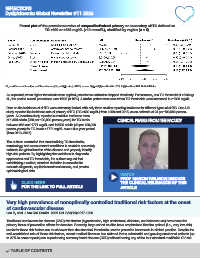
             Forest plot of the prevalence rates of unspecified/mixed primary or secondary sHTG defined as
                            TG >880 or >886 mg/dL (>10 mmol/L), stratified by region (n = 5).                      Dyslipidaemia


     CI, confidence interval; n, number of cases; N, sample size; sHTG, severe hypertriglyceridaemia; TG, triglycerides; US, United States.


     As expected, when higher thresholds were applied, prevalence estimates dropped drastically. For instance, at a TG threshold of >886mg/
     dL, the pooled overall prevalence was 1:526 (0.19%). A similar pattern was seen when TG thresholds were increased to >1000 mg/dL.

     Data on the incidence of sHTG were extremely limited, with only three studies reporting incidence for different types of sHTG. One US
     study reported the incidence rate of primary sHTG (TG >500 mg/dL) from 1998 and 2015, as an estimate of 24 per 100,000 person-
     years. A Canadian study reported cumulative incidence rates
     of 1:400 adults (250 per 100,000 person-years) for TG levels       CLINICAL PEARLS FROM THE FACULTY
     between 886 and 1771 mg/dL and 1:2500 adults (40 per 100,000
     person-years) for TG levels >1771 mg/dL over a five-year period
     (from 2010–2015).

     The authors concluded that standardising TG thresholds,
     terminology, and measurement conditions is crucial to accurately
     estimate the global burden of the disease and properly identify
     high-risk patients. By highlighting the variations in diagnostic
     approaches and TG thresholds, the authors argued that
     establishing a unified, standard definition is essential for
     accurate diagnosis, equitable treatment access, and precise
     epidemiological data.
                                                                           WATCH
                                                                           PROF. MARCIN WELNICKI DISCUSS
              CLICK HERE                                                   THE CLINICAL RELEVANCE OF THIS
              FOR THE LINK TO FULL ARTICLE                                 ARTICLE.


     Very high prevalence of nonoptimally controlled traditional risk factors at the onset
     of cardiovascular disease.

     Lee H, et al. J Am Coll Cardiol. 2025 Oct 7;86(14):1017-1029.

     Traditional cardiovascular disease (CVD) risk factors (hypertension, high cholesterol, diabetes, and tobacco use) have been the
     primary focus of prevention efforts for decades. Recently, large cohort studies have emphasised that the optimal (i.e., very low-risk)
     levels for these risk factors are much lower than the standard thresholds used to prescribe treatments in clinical practice. Despite the
     well-established role of these risk factors, recent medical literature has claimed that a substantial and growing number of patients (up
     to 27% in some reports) are experiencing coronary heart disease (CHD) without having any of the four standard modifiable CV risk


          TABLE OF CONTENTS

